The Missing Step Between Setup and Punchline
Learn how a joke bridge turns a setup’s expectation into a surprising, earned punchline, with a weeklong routine for shaping and revising comic logic.
A joke bridge makes the punchline feel both unexpected and fair: the setup points one way, a small turn redirects the logic, and the final line lands somewhere the audience can recognize. In joke writing, that missing step is often the difference between a clever thought and a laugh that arrives naturally.
Think of the bridge as a stepping-stone across a narrow gap. It does not need to be large or flashy; it needs to give the audience just enough footing to follow the turn after it happens. A strong bridge often hides in a word’s second meaning, a character’s faulty assumption, or a detail that changes what the setup seems to promise.
What does a joke bridge actually do?
A setup invites a prediction. “My landlord said the apartment had character” suggests a charming quirk, perhaps an odd window or an uneven floor. A punchline that jumps to an unrelated complaint may surprise, but it can feel random because the audience cannot see how the setup led there.
The bridge supplies that connection without explaining the joke. Imagine the writer continues: “I met the character. It’s a raccoon with a key.” The added idea makes “character” mean a literal resident with agency. The turn is odd, but the word in the setup has prepared it. The audience can make the connection a beat after the reveal, which is often where the pleasure sits.
That does not mean every joke needs a separate sentence between setup and punchline. The bridge may be a single word, a pause, or an implied piece of reasoning. The useful question is not, “Have I added enough?” It is, “Can the audience reconstruct the comic logic after the turn?”
How can you plan a week of bridge work?
Give the idea room to change rather than trying to force a finished joke in one sitting. This weeklong routine focuses on one setup at a time. Use a notebook, a voice memo, or a plain document; the tool matters less than keeping the setup and its possible turns together.
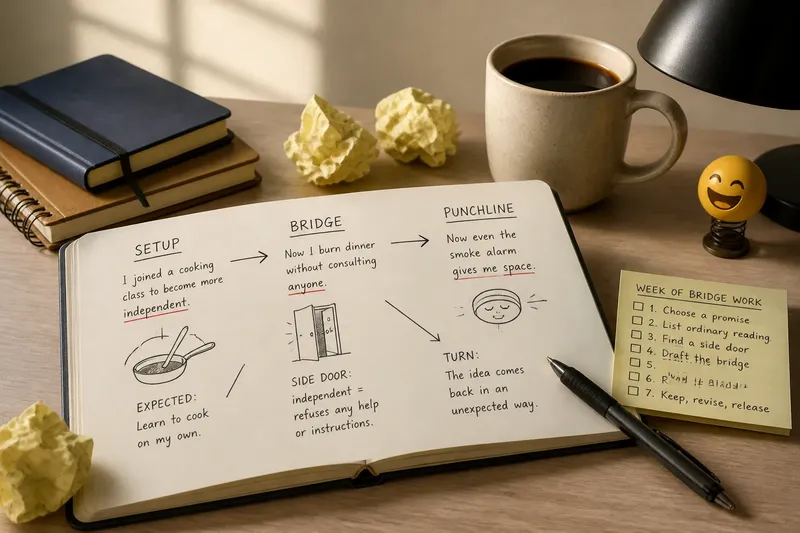
- Day one: Choose a promise. Write a setup that creates a clear expectation, such as “I joined a cooking class to become more independent.” Underline the word or assumption that seems most predictable.
- Day two: List the ordinary reading. Note what a listener is likely to imagine next. For the cooking-class setup, that might be learning to prepare meals without help. This is not the punchline; it is the path you will later divert.
- Day three: Find a side door. Look for a second meaning, an unusual cause, or a hidden rule inside the setup. “Independent” could mean refusing help so completely that the speaker rejects a recipe’s instructions, even when the recipe is printed on the food.
- Day four: Draft the bridge. Add the smallest detail that makes the side door visible. For instance: “Now I burn dinner without consulting anyone.” That line connects independence to the speaker’s stubbornness, though it may still be too obvious or too long.
- Day five: Move the reveal. Try placing the most surprising word at the end of the punchline. “I wanted to cook independently. Now even the smoke alarm gives me space.” The alarm’s imagined politeness makes the setup’s idea recur in an unexpected form.
- Day six: Read it aloud. Mark where you naturally pause and where the sentence makes you stumble. If the bridge explains the turn twice, cut one explanation. If listeners would need a missing fact, add a compact clue rather than a paragraph of setup.
- Day seven: Keep, revise, or release. Compare the latest version with the original. Keep the bridge if it makes the punchline easier to understand without making it predictable. If every version requires a footnote, save the underlying idea and start with a clearer setup.
This schedule is a drafting aid, not a deadline. A writer might discover the bridge on the first day or need longer to find a turn that belongs to the setup. The useful habit is to separate the stages: identify the promise, explore the logic, then choose the reveal.
How do you tell whether the turn feels earned?
Check the connection from both directions. Before the punchline, the setup should support the ordinary expectation. After the punchline, the audience should be able to trace a route back through the bridge. If either direction is missing, the joke may feel telegraphed or arbitrary.
For an invented illustration, say a writer begins, “My phone says I have too many open tabs.” The ordinary reading is browser clutter. A bridge could establish that the speaker treats every notification as an obligation: “I opened a new one to look up how to close the first.” The expected result is a punchline about the phone’s tabs becoming a kind of personal workload, not a sudden detour into unrelated phone trouble.
Now inspect the bridge for unnecessary explanation. If the setup already makes the speaker’s anxious habit clear, spelling out that habit can dull the reveal. Conversely, if the punchline depends on the audience knowing an obscure app feature, the connection may be too private. Make the logic visible through a familiar behavior, not a lecture.
What should you ask while revising a joke bridge?
How much of the bridge should the audience hear?
Only enough to make the turn legible. If the audience can supply the connection, leave it implied; if the punchline seems to come from nowhere, add one concrete cue.
Can a pause do the work of a bridge?
Yes, when the setup already contains the clue and timing lets the audience form an expectation. A pause cannot replace missing logic, but it can give a listener a moment to commit to the wrong reading.
What if the punchline makes sense but gets no laugh?
Check whether its wording reveals the turn too early or whether the setup points toward a stronger, more familiar expectation. The bridge may be sound while the surprise is mild, so try changing the final image or moving the reveal later in the sentence.
Should every joke have one clear interpretation?
No; a joke can support more than one reading. The audience still needs a clear route to at least one of them, and extra meanings work best when they enrich the turn rather than obscure it.
Where do bridges tend to break?
A common snag is the “because” bridge: the writer explains the speaker’s reasoning until the audience has no discovery left to make. Another is the private bridge, which relies on a detail only the writer knows. A third is the false bridge, where a connective phrase promises causation but the punchline changes subjects.
Read each sentence and ask what new job it performs. Does it establish the expectation, plant the clue, or deliver the turn? If two lines perform the same job, try cutting one. If a line does none of them, it may be a detour rather than a bridge.
For live delivery, keep the spoken version easy to follow on the first hearing. A written joke can invite rereading; a stage line usually has to carry its logic in real time. Use a familiar noun before an abstract explanation, and place the important turn where your voice can make it clear. Delivery can sharpen a bridge, but it cannot repair a missing connection.
How does the missing step strengthen a joke?
The bridge gives surprise a reason to belong. It lets the setup plant an expectation, then changes the audience’s understanding without asking them to accept a random leap. When revising the joke, keep the main search phrase—“setup and punchline”—in mind as a relationship, not a pair of isolated lines: the bridge is the small piece of logic that makes both parts work together.
On the next draft, circle the setup’s most loaded word and write down its ordinary meaning before chasing alternatives. Then add only the clue that helps the audience follow the turn. That modest edit can make a punchline feel less like a trick and more like a conclusion the listener was delighted not to predict.