From Drawing-Room Farce to the Modern Sketch
From drawing-room farce to the modern sketch, see how shifting scene length changes comic structure and how to reshape a tangled premise into a clear, playable form.
A drawing-room farce can spend an evening tightening one misunderstanding; a modern sketch may have only a few minutes to make its premise legible and turn it. That shift in format is more than a cut in running time. It changes what a comic scene must explain, how it can build pressure, and where a writer should look when the draft feels stuck.
Why does the premise take too long to arrive?
Farce often earns its complications through a clear starting arrangement: people occupy a shared space, conceal something, and misread what they see or hear. The audience gets time to learn the room’s social rules before the trouble multiplies. In a shorter sketch, a long runway can spend the audience’s attention before the central comic idea appears.
This is usually a problem of delayed orientation, not a shortage of jokes. The writer may be explaining the backstory, introducing several people, or letting characters discuss a situation the audience could understand from one visible action.
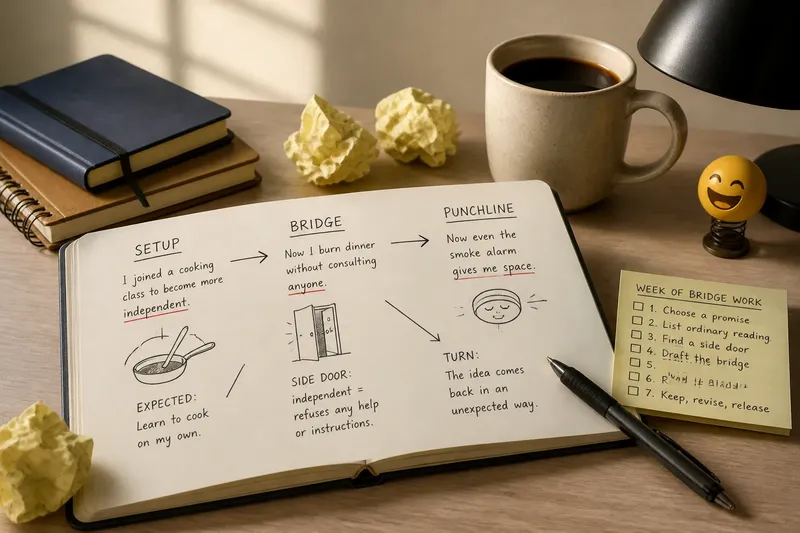
Try identifying the first moment when the audience can describe the premise in a sentence. Put that moment near the beginning, then keep only the information needed to understand why it matters. A character hiding a second identity, for instance, may need one clear sign of the disguise and one person who has a reason to believe it. The entire history of the deception can wait unless a later beat depends on it.
Imagine a writer’s draft begins with two office workers discussing a company party, a seating chart, and their manager’s recent travel. The actual comic engine is that one worker mistakes a delivery person for the new manager. The writer could open on the mistaken introduction and let the party details surface only when they affect the exchange. The expected result is a faster grasp of the scene’s central confusion, without discarding useful context.
Why does a farce premise feel cramped in sketch form?
A long stage farce can make a single location feel like a machine with many moving parts: entrances, exits, hidden objects, overheard fragments, and shifting loyalties. A sketch has less room to install that machinery. Trying to preserve every door, secret, and character from a larger design can make a short piece feel like a plot summary being acted out.
The usual cause is treating compression as simple deletion. Remove scenes at random and the surviving events may no longer make sense; keep every cause and explanation, and the sketch still carries the weight of the longer form.
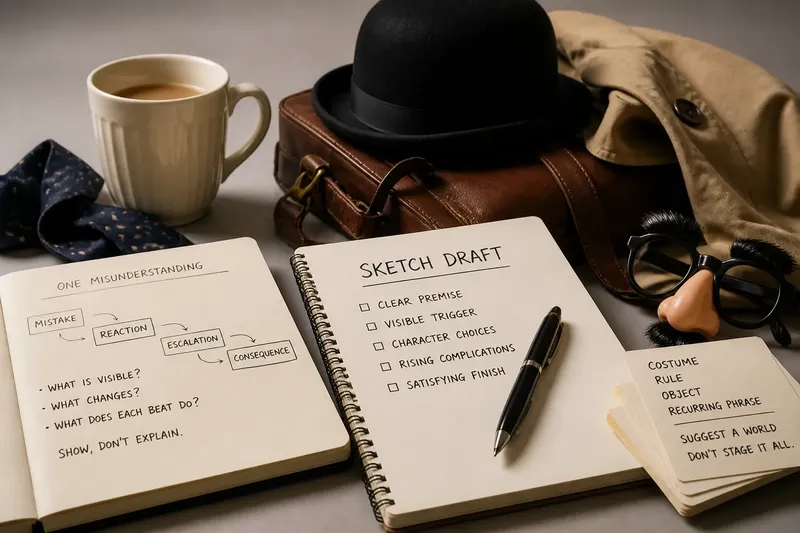
Instead, choose the one misunderstanding that gives the premise its distinctive comic shape. Ask what must be visible for the audience to follow it, what can be implied, and what belongs to the larger story but not this scene. A sketch can suggest a whole social world through a uniform, a recurring phrase, or a rule everyone obeys. It does not need to stage the whole world.
Think of the longer farce as a drawer full of labeled tools and the sketch as the one tool needed for the task at hand. The drawer is useful, but carrying all of it into the scene slows the work. Keep the items that make the central action readable; set aside the rest rather than trying to squeeze them in.
Why do the characters keep explaining the misunderstanding?
In a tightly arranged farce, misunderstandings can travel through information: one person hears a name, another sees an object, and a third draws the wrong conclusion. In a compressed scene, writers sometimes repeat the explanation in dialogue because they fear the audience has missed the connection. The result is a sketch that pauses to narrate its own mechanism.
That repetition often signals that the misunderstanding lacks a clean, observable trigger. If the audience cannot see what was misheard or why the mistaken belief is plausible, extra explanation only makes the scene more laborious.
Give the confusion a concrete source: a similar-sounding name, a misplaced document, an interrupted announcement, or a costume that carries a specific meaning in the scene. Then let characters behave according to what they believe. Their choices should reveal the misunderstanding more clearly than another line of exposition could.
During revision, mark each sentence that tells the audience what a character believes. Keep the ones that change the action or sharpen the stakes. For the rest, look for a gesture, object, entrance, or response that can make the same information visible. The point is not to ban explanation; it is to stop dialogue from doing a job the scene can do more vividly.
Why does the sketch stop after its first good idea?
Short form does not mean one amusing premise followed by a quick exit. A sketch still needs movement: the situation changes, the characters adapt, and the audience sees a consequence. Farce often creates that movement through a growing web of mistaken assumptions. A shorter sketch can use fewer turns, but each one needs to alter what the characters can do next.
A common cause of a stalled middle is repeating the same misunderstanding at the same intensity. New lines may be clever, yet the scene remains in its original shape. Ask what has changed since the opening: who knows more, who has lost control, or what new obligation has appeared?
Try arranging the scene’s major turns as a simple chain of changing conditions. For example: a person is mistaken for an inspector; the staff begin hiding ordinary office habits; the supposed inspector is asked to approve a strange policy; the real inspector arrives and is treated as an impostor. This is an invented sketch premise, not a report of an actual scene. Its useful feature is that each turn changes the social situation rather than merely repeating the initial error.
In revision, cut a beat if removing it leaves the characters’ options and the audience’s understanding unchanged. Keep the beats that force a fresh response. This gives a compact scene the sense of forward motion that a longer farce can build across many entrances and revelations.
Why does the ending feel like an abrupt stop?
Writers sometimes mistake brevity for a finish. They reach a strong line or an amusing image and end immediately, even though the scene has not answered the question it raised. At the other extreme, they keep adding complications after the premise has already reached its natural limit.
The cause is often a missing decision about what the ending should complete. A scene may resolve the misunderstanding, expose the social rule behind it, or show that the characters are trapped by the behavior they began with. It need not do all three.
Before polishing the last exchange, state what has changed by the end. If the answer is “nothing,” the final beat may be a punchline without a scene ending. If the answer is “everything,” the piece may be trying to resolve more plot than its form can comfortably carry.
A useful ending often turns the premise’s original rule against the characters. Someone who has spent the scene insisting that only official forms count may discover that the form they need is the one they refused to read. The ending lands because it completes the scene’s particular logic, not because it adds another unrelated surprise. Leave room for the audience to register that turn rather than explaining it afterward.
What should you check when adapting a long scene?
When a farce-like idea is not working in a short sketch, diagnose the pressure point before cutting dialogue. These checks help separate a format problem from a line-level problem:
- Premise: Can a reader state the central confusion after the opening? If not, bring the triggering action forward.
- Cast: Does each character change what can happen? If two people serve the same function, combine or remove one.
- Space: Does the scene require many locations or complicated traffic? Keep the location that best supports the action and imply the rest.
- Information: Is the audience being told the same fact more than once? Retain the clearest delivery and let behavior carry the rest.
- Turns: Does each major beat alter a belief, obligation, or available choice? Revise repetitions that leave the situation untouched.
- Ending: Does the final moment resolve or transform the premise? If it only stops the scene, build a consequence into the last beat.
Make one pass for each problem rather than trying to repair everything at once. A scene with too much backstory may also have too many characters, but cutting both in the same pass can obscure which change helped. Keep a copy of the earlier draft so you can compare the scene’s clarity and movement, not simply its length.
How does a shorter form change what the audience needs?
A long farce can let the audience enjoy anticipation: viewers may understand a secret before a character does and wait for the collision. A short sketch can use that pleasure, but it must establish the gap in knowledge promptly. It may also choose a different kind of payoff, such as a sudden reversal or a final image that makes the opening action look different.
That difference helps answer several common form questions:
Does every sketch need a misunderstanding?
No. A misunderstanding is one engine inherited from farce, not a rule of sketch writing. A sketch can turn on a social ritual, a character’s fixed logic, or a situation that changes as people respond to it.
Can a sketch have a running story?
Yes, if the story gives the short form a clear reason to continue. Each scene still needs its own readable action, rather than relying on a distant payoff to make the present moment matter.
How much backstory should the audience get?
Give the audience the context needed to understand the current choice and its consequence. Add more only when it changes how that choice reads.
Should the ending explain the joke?
Usually not if the action or final image already makes the turn clear. If the ending needs a long explanation, revisit whether the setup established the scene’s rule well enough.
How can you choose the right form for the idea?
Start with the experience the premise seems to promise. If its pleasure depends on watching a secret pass through a network of people and objects, a longer farce may give those connections room to tighten. If the idea has one sharp social rule, one compact reversal, or a character whose behavior reveals itself quickly, a sketch may be the more natural shape.
That choice is not a verdict on the idea’s quality. A long premise can contain a short, self-sufficient scene, and a sketch premise can open onto a larger story. The practical question is where the audience’s attention should rest: on the accumulating arrangement or on the decisive change.
To reshape a piece from drawing-room farce to the modern sketch, preserve the comic relationship that makes it worth staging, not every mechanism that once supported it. Put the premise where the audience can see it, make each turn change the situation, and let the ending complete the scene’s own logic. Format is not just a container for a joke; it decides how long the audience waits to see what the joke can do.
When the draft still feels crowded, read the characters’ actions without their explanatory dialogue. If the scene remains understandable, the action is carrying its share. If it becomes opaque, restore only the line or detail that makes the next choice clear. That small distinction can show whether the piece needs a trim, a sharper premise, or the breathing room of a longer form.